
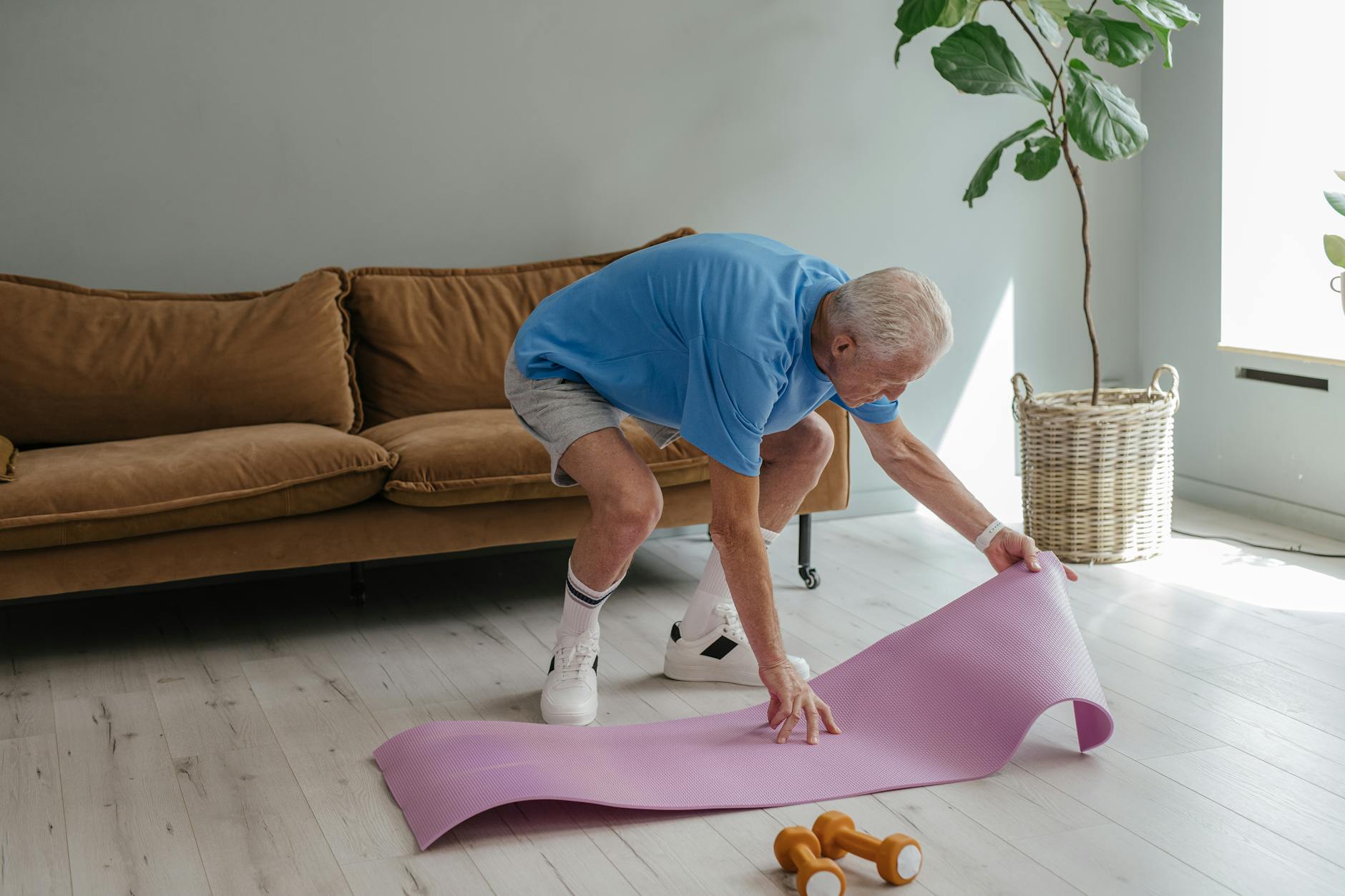
Balance Training for Older Adults: Stay Independent and Fall-Proof
Title: Balance Exercises for Seniors: Stay Independent and Fall-Proof
Stephen's two video programs — $12.99 for both
Active Play + 5-in-1 Training, one-time price, 30-day money-back guarantee.
Get the Complete Bundle →Description: Discover how functional balance exercises for seniors enhance daily living skills, boost mobility, and prevent falls naturally. Never leave the playground.
I get younger every year—and you can too, provided you stop treating your living room like a museum.
As someone who has spent decades pushing my body to its limits in Masters swimming and lifelong movement exploration, I have learned a fundamental truth that most of modern society gets completely backwards: balance is not something you lose simply because the calendar turns another page; it is something you lose because you stop challenging your nervous system. Walk into most retirement communities or senior centers, and you will see chairs arranged in neat, orderly rows facing a television screen, encouraging a sedentary existence that actively breeds instability. That is no way to live. The human body was engineered for exploration, adaptation, and joyful coordination.
When we look at the clinical literature sitting in the National Institutes of Health databases regarding balance training for older adults, the traditional medical establishment often throws up its hands, claiming the evidence for preventing functional decline is only modest or weak. Why is that? Because standard physical therapy often prescribes rigid, uninspired repetitions that treat movement like a chore rather than a game. But when we look at systematic reviews and network meta-analyses in modern geriatric research, a much more exciting picture emerges. Traditional modalities combined with dynamic, multi-directional challenges—what we might call playful movement—fundamentally rewire the brain-body connection.
Think about what happens when you step outside and interact with adult playground equipment or navigate an uneven surface. You are not just strengthening your ankles; you are forcing your cerebellum to rapidly process visual, vestibular, and proprioceptive signals all at once. Challenge both sides of your brain—every single day. When you engage in deliberate, playful coordination tasks, you stimulate neuroplasticity in a way that stationary weight machines simply cannot replicate. Research shows that targeted balance exercises can dramatically reduce the risk of debilitating falls, keeping you fiercely independent and roaming free.
Now, let us talk about how to translate this science into your daily routine without turning your house into a clinical laboratory. You do not need expensive contraptions or a sterile gym membership. You need a little imagination and a willingness to look slightly ridiculous in the pursuit of vitality.
Why Standard Workouts Miss the Mark
For years, fitness culture has obsessed over linear strength. We are told to sit on a machine, push a heavy stack of metal, and call it a day. But life does not happen on a linear track. Slips, trips, and loss of footing happen in three dimensions, usually when we are distracted—carrying groceries, turning to wave at a neighbor, or stepping off a curb.
If you want to protect an elderly parent falling hazards, or if you are looking to bulletproof your own movement longevity, you have to train the way you live. That means introducing unpredictable elements into your physical practice. It is about embracing the wobble. When you stand on one foot while brushing your teeth, or practice controlled weight shifts while tossing a small ball against a wall, you are training your reflexes to catch you before gravity wins.
Practical Playful Movement for Everyday Life
Let us get down to brass tacks. How do we actually build superior stability without dying of boredom? Here are three functional practices you can integrate into your day immediately:
1. The Single-Leg Clock Tap: Stand near a kitchen counter for safety if needed. Lift your right foot and hover it slightly above the floor. Imagine you are standing in the center of a clock face. Use your left foot to gently tap the floor at 12 o'clock, 3 o'clock, and 6 o'clock. Do not rush. The magic happens in the unstable transition between taps. Switch legs and repeat.
2. Heel-to-Toe Dynamic Walking: Forget walking on a treadmill staring at a wall. Find a hallway in your home and practice tightrope walking—placing the heel of one foot directly against the toe of the other. To make it a true brain health exercise, recite the alphabet backward while you walk. If your brain has to chew gum and walk at the same time, your nervous system is forced to adapt and grow stronger.
3. The Balance Board Adventure: Investing in the best balance board for seniors transforms a boring living room floor into an active stability lab. Shifting your weight side to side and front to back while maintaining a soft, athletic knee bend fires up every stabilizing muscle from your arches to your core.
The Playground Doesn't Care How Old You Are
People often ask me what my secret is. They look at an octogenarian diving into pools or balancing on dynamic boards and assume I possess some genetic anomaly. Nonsense. My secret is simply that I refuse to stop playing.
The moment you accept physical decline as an inevitable consequence of aging, you have handed over the keys to your independence. But the moment you decide that your living room, your backyard, and your local park are venues for continuous learning, everything shifts. You begin to look at curbs, steps, and slopes not as obstacles to be feared, but as miniature playgrounds inviting you to test your coordination.
Fall prevention exercises video course modules and structured routines are exceptionally helpful, but they are only valuable if you actually enjoy doing them. Movement should feel like recess, not a rehabilitation sentence. When you approach your daily mobility with curiosity, humor, and a child-like refusal to quit, your body responds with resilience.
Just keep moving. Explore new ways to challenge your balance, protect your functional independence, and keep your mind sharp as a tack.
Ready to take your daily movement to the next level and put these principles into action? Explore the complete Never Leave The Playground video collection at neverleavetheplayground.com/videos for just $12.99 and start your journey today.
Watch Stephen in Action
See these exercises demonstrated in Stephen's video program — playful movements anyone can do, at any age.
Browse the Video Collection →Stephen Jepson is 85 — and still teaching the world to move
His video program walks you through the exact playful exercises in this article — balance, coordination, and brain challenges you can do at home, at any age. Gentle, fun, and proven.
Stay on the Playground
Get Stephen's tips on movement, brain health, and longevity — free.
Stephen's two video programs — $12.99 for both
Active Play + 5-in-1 Training, one-time price, 30-day money-back guarantee.
Get the Complete Bundle →